

How to Tell If Your IT Support Is Actually the Problem
Introduction
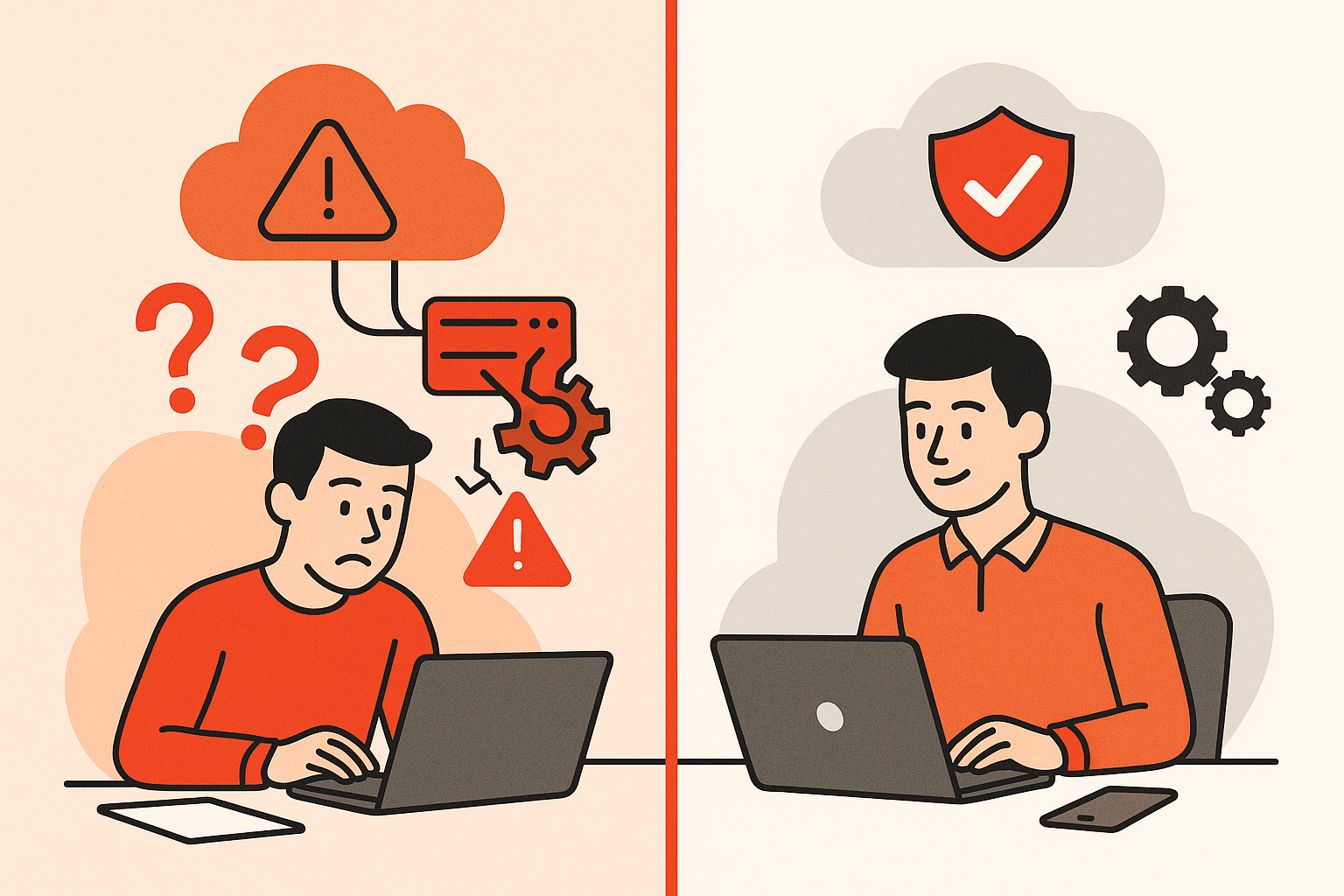
Most businesses assume that when something goes wrong with their technology, the issue lies within the systems themselves. Slow computers, network outages, security gaps, and recurring errors are often blamed on ageing infrastructure, software limitations, or even staff misuse. What many organisations fail to consider is that their IT support provider may be contributing to, or even causing, these problems.
IT support is meant to reduce risk, improve efficiency, and provide stability. When it does the opposite, it quietly drains time, money, and trust. The difficulty is that poor IT support rarely presents itself in obvious ways. It tends to hide behind technical language, vague explanations, and reactive fixes that never address root causes.
How to Tell If Your IT Support Is Actually the Problem
Lack of Proactive Monitoring and Prevention
One of the clearest indicators of ineffective IT support is a reactive approach. If your provider only engages when something breaks, rather than preventing issues before they occur, your business is operating in a constant cycle of disruption.
Professional IT support should include proactive monitoring of systems, networks, and devices. This involves identifying potential risks, applying updates before vulnerabilities are exploited, and resolving performance issues before users notice them.
If your business frequently experiences unexpected downtime, repeated issues, or last minute fixes, it suggests that your provider is not actively managing your systems. Instead, they are responding to problems that should have been avoided entirely.
Recurring Issues That Are Never Fully Resolved
Recurring technical problems are not just frustrating, they are a strong signal of poor root cause analysis. If the same issue keeps reappearing, it means the underlying problem has not been properly identified or fixed.
This might include persistent network dropouts, repeated login failures, email delivery issues, or software crashes that seem to return without explanation. Each recurrence represents lost productivity and increased reliance on support.
Effective IT support focuses on long term solutions. Temporary fixes may restore functionality quickly, but they should always be followed by a deeper investigation. If your provider moves on as soon as the immediate issue is resolved, they are prioritising speed over quality.
Slow Response and Resolution Times
Speed matters in IT support, but not just in terms of acknowledging a problem. The real measure of quality is how quickly and effectively issues are resolved.
If your team regularly waits hours or days for responses, or if simple issues take far longer than expected to fix, your provider may lack the resources, processes, or expertise required to support your business properly.
Slow resolution times often point to deeper problems within the support structure. This can include understaffing, poor ticket management systems, or reliance on junior technicians who lack experience.
Poor Communication and Lack of Transparency
Communication is one of the most overlooked aspects of IT support. When providers fail to explain issues clearly, businesses are left in the dark, unable to make informed decisions.
Warning signs include vague explanations, excessive technical jargon, and a reluctance to provide detailed reports. If you frequently hear unclear or evasive responses, it may indicate that your provider is not fully in control of the situation.
Strong IT support providers communicate in plain terms, offering clear explanations of problems, solutions, and potential risks. They provide regular updates, document their work, and ensure that clients understand what is happening within their systems.
No Clear Strategy or Long Term Planning
IT should not be treated as a series of isolated fixes. It requires a structured strategy that aligns with your business goals, supports growth, and mitigates risk.
If your provider does not offer guidance on future planning, system upgrades, or infrastructure improvements, they are functioning purely as a reactive service.
Businesses should expect their IT support to act as a strategic partner. This includes advising on scalability, recommending improvements, and planning for future requirements such as cloud migration, cybersecurity upgrades, and system integrations.
Frequent Downtime and Performance Issues
Frequent downtime is one of the most visible signs of poor IT support. While occasional issues are inevitable, consistent disruptions indicate deeper problems in system management.
This may include slow network speeds, unresponsive applications, or systems that fail during peak usage. These issues often stem from poor configuration, inadequate monitoring, or failure to maintain infrastructure properly.
Security Is Treated as an Afterthought
Cybersecurity is no longer optional. Businesses face constant threats, and weak security measures can lead to data breaches, financial loss, and reputational damage.
If your IT support provider does not actively manage security, it is a major red flag. This includes failing to implement updates, neglecting endpoint protection, or lacking clear security policies.
Strong IT support integrates security into every aspect of system management, ensuring that risks are minimised and vulnerabilities are addressed proactively.
Hidden Costs and Unclear Pricing Structures
IT support should provide clarity in both service delivery and pricing. If your provider frequently charges unexpected fees or lacks transparent pricing, it can create financial uncertainty.
Hidden costs often arise from reactive work, emergency fixes, or services that should have been included in a managed agreement.
Lack of Documentation and Poor Record Keeping
Documentation is a fundamental part of effective IT support. Without it, systems become difficult to manage, troubleshoot, and improve.
If your provider does not maintain accurate records of configurations, updates, and changes, it increases the risk of errors and delays.
High Staff Turnover or Inconsistent Support Personnel
Consistency is critical in IT support. When support staff frequently change, it disrupts continuity and reduces the quality of service.
New technicians may lack familiarity with your systems, leading to longer resolution times and inconsistent advice.
Limited Understanding of Your Business
IT support should be tailored to your specific needs. If your provider treats your business as a generic client, without understanding your operations, workflows, and priorities, the service will lack effectiveness.
Resistance to Change or Improvement
If your IT support provider resists new ideas or avoids adopting modern solutions, it may indicate a lack of capability or willingness to evolve.
Blame Culture Instead of Accountability
When problems arise, poor IT support providers often shift blame onto users, software, or external factors. A consistent pattern of deflection is concerning and undermines trust.
No Measurable Performance Metrics
Without measurable performance metrics, it is difficult to assess the quality of IT support. If your provider does not track or report on key indicators, you have no clear way to evaluate their effectiveness.
What Businesses Should Do If IT Support Is the Problem
Recognising the issue is only the first step. Businesses must take practical action to address it.
Start by reviewing your current agreement and identifying any gaps in service expectations. Request detailed reports on performance, security, and support activity. Consider an independent audit to gain an unbiased view.
If problems persist, transitioning to a new provider may be necessary. With proper planning, this can be done with minimal disruption and significant long term benefit.
FAQs
Q1: What are the most common signs of poor IT support
The most common signs include slow response times, recurring issues, lack of proactive monitoring, poor communication, and frequent downtime.
Q2: How can I measure the performance of my IT support provider
You can measure performance through service level agreements, response and resolution times, system uptime, and regular reporting on key metrics.
Q3: Is it normal to experience occasional IT issues
Yes, occasional issues are expected. However, frequent or recurring problems indicate deeper issues in system management or support quality.
Q4: Should IT support providers offer strategic advice
Yes, effective IT support should include guidance on future planning, system improvements, and aligning technology with business goals.
Q5: How do I switch IT support providers without disruption
Plan the transition carefully, ensure proper documentation is available, and work with the new provider to manage the handover smoothly.
Q6: Can poor IT support affect business growth
Yes, ineffective IT support can limit productivity, increase costs, and prevent businesses from adopting technologies that support growth.
Conclusion
IT support plays a critical role in the success of modern businesses. When it functions properly, it enables efficiency, protects systems, and supports growth. When it fails, it creates ongoing disruption, hidden costs, and increased risk.
The challenge lies in recognising when your provider is part of the problem. Many businesses tolerate poor service for longer than they should, assuming that issues are unavoidable or simply part of operating technology.
By identifying the warning signs and taking a proactive approach, businesses can regain control of their systems and ensure that their IT support delivers real value. Choosing the right provider is a strategic decision that directly impacts performance, security, and long term success.
If you're seeking expert support in Cybersecurity Solutions, Cloud Computing, IT Infrastructure & Networking, Managed IT Support, Business Continuity & Data Backup, or VoIP & Unified Communications, visit our website, Dig-It Solutions, to discover how we can help your business thrive. Contact us online or call 020 8482 4020 to speak with our team today.


