
Why Cloud Systems Are Ideal for Multi Office Businesses

Introduction
Running a business across multiple offices brings a unique set of challenges. Communication becomes more complex, systems are harder to standardise, data access can be inconsistent, and IT costs often rise faster than expected. Many growing organisations reach a point where traditional on site servers and disconnected software no longer support the way their teams actually work.
This is where cloud systems have become a practical and often necessary solution. Cloud based IT infrastructure allows businesses to centralise data, applications, and security while giving staff in different locations equal access to the tools they need. Whether a company operates two regional offices or dozens of locations across the country, cloud systems provide the consistency and flexibility required to operate as one organisation rather than a collection of separate sites.
Why Cloud Systems Are Ideal for Multi Office Businesses
Centralised access to data and systems
One of the biggest advantages of cloud systems for multi office businesses is centralised access. All users connect to the same core systems, regardless of location. Files, applications, and databases are stored in a single cloud environment rather than scattered across local servers.
This means employees in different offices always work with the same information. There are no issues with outdated files, duplicated records, or conflicting versions of documents. Sales teams, finance departments, and operational staff all see the same data in real time.
Centralisation also simplifies onboarding. New staff can be given access to systems without complex local server configuration. This is especially valuable for businesses that open new offices or regularly move staff between locations.
Consistent user experience across offices
In traditional multi site setups, each office often develops its own IT environment over time. Different hardware, different software versions, and different ways of working can emerge. This inconsistency creates inefficiency and increases support demands.
Cloud systems allow businesses to standardise their IT environment. Users log into the same platforms, use the same tools, and follow the same processes no matter where they are based. This consistency improves productivity and reduces training time, as staff can move between offices without needing to learn new systems.
From a management perspective, standardisation also makes performance easier to measure and processes easier to refine across the organisation.
Improved collaboration between teams
Cloud platforms are designed with collaboration in mind. Tools for shared document editing, messaging, video meetings, and project management are built into many cloud ecosystems.
For multi office businesses, this removes the sense of distance between locations. Teams can collaborate on documents simultaneously, hold virtual meetings without technical barriers, and share updates instantly. This helps maintain alignment between offices and reduces the risk of silos forming.
Effective collaboration is particularly important for leadership teams and project based work, where decisions need to be made quickly and communicated clearly across the business.
Easier support for remote and hybrid working
Many multi office businesses now operate alongside remote or hybrid working arrangements. Staff may work from home, travel between sites, or spend time on the road.
Cloud systems support this flexibility by allowing secure access from any location with an internet connection. Employees do not need to be physically present in a specific office to access essential systems. This improves resilience and allows businesses to adapt to changing working patterns without major infrastructure changes.
From an IT support standpoint, cloud access also reduces the need for complex remote desktop solutions or office specific network dependencies.
Scalability without major infrastructure changes
Growth often creates pressure on traditional IT systems. Opening a new office can require servers, networking equipment, backup solutions, and ongoing maintenance. This can slow expansion and increase upfront costs.
Cloud systems are inherently scalable. New users, offices, or services can be added without purchasing physical infrastructure. Businesses can increase storage, computing capacity, or application licences as needed, often within minutes.
This scalability makes cloud systems ideal for businesses that expect growth or seasonal fluctuations. IT resources can be aligned closely with actual business demand rather than fixed capacity.
Predictable and controlled costs
Managing IT budgets across multiple offices can be difficult when each site has its own hardware and maintenance requirements. Unexpected failures or upgrades can create unplanned expenses.
Cloud systems typically operate on a subscription based model, which provides clearer cost forecasting. Businesses pay for the services they use rather than maintaining underused hardware. This approach often reduces capital expenditure and spreads costs more evenly over time.
For finance teams, predictable IT costs make budgeting simpler. For IT managers, it reduces pressure to delay necessary upgrades due to high upfront spending.
Simplified IT management and support
Supporting multiple offices with traditional infrastructure often requires on site visits, complex troubleshooting, and coordination with local staff. This increases response times and operational overhead.
Cloud systems centralise management tasks. Updates, security policies, user access, and monitoring can all be handled from a single administrative platform. IT teams can resolve many issues remotely without needing to attend each office in person.
This efficiency allows internal IT teams or managed service providers to focus on strategic improvements rather than constant maintenance.
Enhanced security across locations
Security is a major concern for multi office businesses, particularly when data is stored in multiple physical locations. Inconsistent security practices between offices can create vulnerabilities.
Cloud platforms typically offer robust security features, including encryption, access controls, multi factor authentication, and continuous monitoring. These protections are applied consistently across all users and locations.
Centralised security management also makes it easier to enforce company wide policies. If an employee leaves the business, access can be revoked instantly across all systems. If a device is lost, data can often be protected or wiped remotely.
While no system is completely risk free, cloud providers invest heavily in security infrastructure that would be difficult for most individual businesses to replicate internally.
Reliable backup and disaster recovery
Data protection becomes more complex when multiple offices maintain their own servers and backups. Ensuring consistent backup practices across sites is challenging, and recovery times can vary significantly.
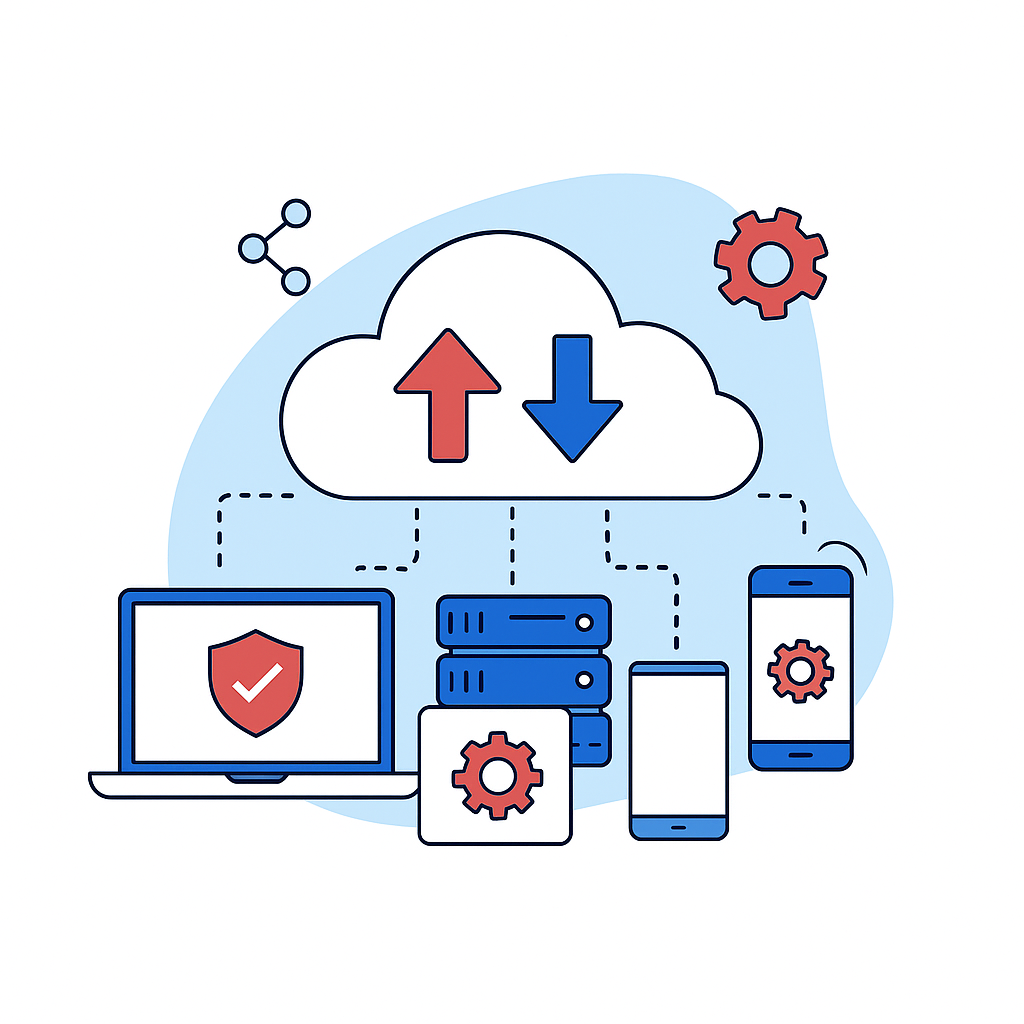
Cloud systems usually include automated backup and disaster recovery options. Data is stored redundantly across multiple data centres, reducing the risk of loss due to hardware failure, theft, or local incidents.
For multi office businesses, this means business continuity plans are easier to implement and more reliable. If one office experiences an outage, staff can often continue working from another location with minimal disruption.
Faster deployment of new tools and updates
Rolling out new software across multiple offices can be time consuming in traditional environments. Each site may require separate installations and testing.
Cloud applications are updated centrally by the provider. New features and security patches are deployed automatically, ensuring all users benefit at the same time. This reduces the risk of outdated software and minimises disruption.
For businesses that rely on modern tools to stay competitive, rapid deployment is a significant advantage.
Better integration between systems
Multi office businesses often rely on a mix of software for finance, customer management, operations, and communication. Integrating these systems across locations can be complex.
Many cloud platforms are designed to integrate easily with other services through standard interfaces. This allows data to flow between systems more smoothly and reduces manual work.
Integrated systems improve reporting, reduce errors, and provide a clearer view of business performance across all offices.
Support for business continuity during office changes
Office moves, refurbishments, or temporary closures can disrupt traditional IT systems. Servers may need to be relocated or replaced, creating downtime.
Cloud systems are largely independent of physical office locations. As long as staff have internet access, they can continue working. This resilience is particularly valuable during periods of change or unexpected events.
Multi office businesses benefit from knowing their core systems are not tied to a single building or network.
Easier compliance and governance
Businesses operating across multiple locations often face regulatory and compliance requirements. Managing access, data retention, and audit trails can be challenging with decentralised systems.
Cloud platforms often include built in compliance tools, logging, and reporting features. These help businesses demonstrate control over data access and system usage.
Centralised governance also ensures policies are applied consistently across all offices, reducing the risk of non compliance due to local variations.
Supporting future technology adoption
Cloud systems provide a foundation for adopting emerging technologies such as advanced analytics, artificial intelligence, and automation. Many of these tools are delivered through cloud platforms and integrate more easily with existing cloud infrastructure.
For multi office businesses planning long term growth, cloud adoption helps future proof their IT strategy and keeps options open as technology evolves.
FAQs
Q1: Are cloud systems suitable for small multi office businesses?
Yes. Cloud systems are well suited to small and medium sized businesses with multiple offices. They allow smaller organisations to access enterprise level tools without the cost and complexity of maintaining their own infrastructure. Scalability means systems can grow alongside the business.
Q2: Is cloud access secure for staff working in different locations?
Cloud providers invest heavily in security and offer features such as encryption, access controls, and multi factor authentication. When configured correctly, cloud access is often more secure than traditional on site systems, especially for distributed teams.
Q3: Will cloud systems replace the need for local IT support?
Cloud systems reduce the need for on site infrastructure maintenance, but IT support is still important. Businesses need expertise to manage users, security, integrations, and overall system performance. Many organisations combine cloud platforms with managed IT support.
Q4: What happens if an office loses internet access?
If an office loses connectivity, access to cloud systems may be temporarily unavailable. However, many businesses mitigate this risk with backup internet connections or mobile access. Cloud based disaster recovery also allows staff to work from alternative locations if needed.
Q5: Are cloud systems more expensive than traditional servers?
Costs vary depending on usage and requirements. In many cases, cloud systems reduce long term costs by eliminating hardware purchases, maintenance, and upgrade expenses. Predictable monthly pricing also helps see where money is being spent.
Q6: How long does it take to move a multi office business to the cloud?
Migration times depend on the complexity of existing systems and the number of users. Some moves can be completed in stages over several months. A well planned approach reduces disruption and ensures staff are supported throughout the transition.
Conclusion
For businesses operating across multiple offices, cloud systems offer a practical and efficient way to manage IT without unnecessary complexity. By centralising data, standardising systems, and enabling secure access from any location, cloud platforms help organisations function as a single, connected business rather than isolated sites.
The benefits extend beyond convenience. Improved collaboration, predictable costs, enhanced security, and easier scalability all contribute to stronger operational performance. From an IT support perspective, cloud systems simplify management and allow teams to focus on strategic improvements rather than constant maintenance.
As working patterns continue to evolve and businesses expand across regions, cloud systems provide the flexibility and resilience needed to adapt. For many multi office organisations, moving to the cloud is not simply a technical upgrade but a foundation for sustainable growth and long term efficiency.
If you're seeking expert support in Cybersecurity Solutions, Cloud Computing, IT Infrastructure & Networking, Managed IT Support, Business Continuity & Data Backup, or VoIP & Unified Communications, visit our website, Dig-It Solutions, to discover how we can help your business thrive. Contact us online or call 020 8482 4020 to speak with our team today.


