

What Does “Moving to the Cloud” Actually Mean for a Business?

Introduction
Moving to the cloud has become one of the most important strategic decisions modern organisations make. Whether a business is looking to improve performance, streamline processes, reduce operational costs or modernise its operations, cloud technology has moved from an optional upgrade to a central pillar of digital transformation. Yet many business owners and managers still ask a simple but crucial question. What does moving to the cloud actually mean in practical terms? Is it simply about storing files online or is it a complete shift in how a business operates and delivers services?
The phrase moving to the cloud is often used broadly, but in reality it covers a wide mix of technologies, services and delivery models. It affects data management, security, software access, remote working and even the way teams collaborate. For some organisations it is a small step that focuses on file storage and hosted email. For others it is a full transition that replaces on site servers, legacy systems and physical infrastructure with cloud based platforms that scale automatically and provide greater flexibility.
What Does “Moving to the Cloud” Actually Mean for a Business?
At its simplest, moving to the cloud refers to transferring some or all of a business’s IT systems, data and applications to remote servers hosted and managed by a cloud service provider. Instead of hardware being owned, housed and maintained within the business premises, it is stored in highly secure data centres and accessed over the internet. However, this simple description does not reflect the full scope of what cloud adoption involves.
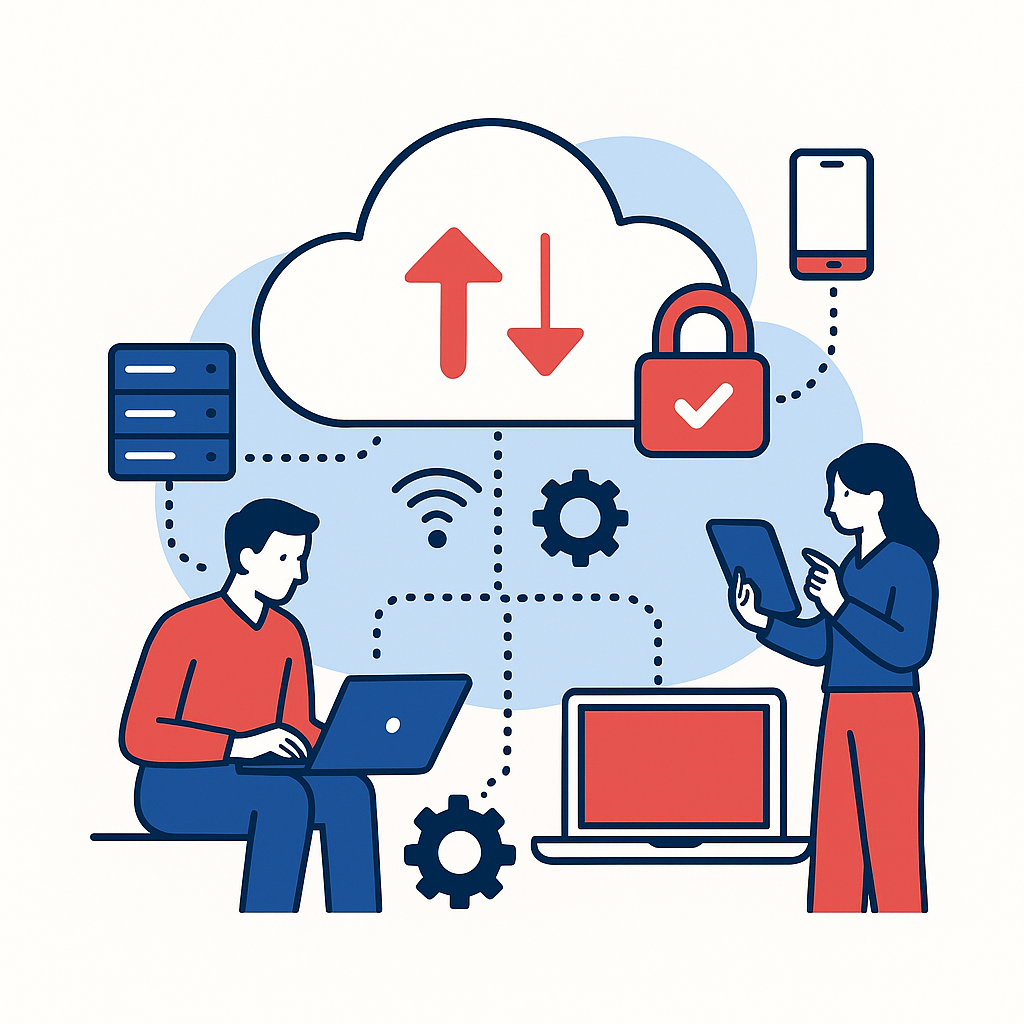
Cloud adoption also introduces several broader changes to the way an organisation operates. These include centralised data access, remote working support, improved resilience and new opportunities for automation. Instead of relying on physical hardware with limited capacity, the cloud provides scalability on demand. A business can increase or reduce its resource usage instantly, allowing technology to grow in line with operational needs.
Security also plays an important role in cloud adoption. Modern cloud platforms use advanced encryption, monitoring tools, compliance frameworks and automatic security updates. This creates a stronger and more reliable security environment than many small or medium sized businesses can achieve on site.
However, moving to the cloud is not only a technical shift. It is a strategic decision that affects workflows, processes, staff training and even the culture of the organisation. Successful cloud adoption requires planning, clear goals and a structured approach that matches the needs of the business.
Understanding the practical changes
For many organisations, the biggest difference after moving to the cloud is how they access their everyday tools. Instead of using installed desktop applications or on site servers, they log in to applications through a browser or secure app. Documents can be accessed from any location. Teams can collaborate in real time. Updates are released automatically without the need to install patches or manually upgrade software.
Cloud platforms also offer consistent performance regardless of location. Staff working from different offices, at home or while travelling can all access the same applications with the same level of security. This helps businesses support flexible working arrangements and reduces dependency on physical office space.
Backing up data becomes far more reliable. Cloud providers offer automatic backups, multiple versions of files and replication across several data centres. This protects a business from data loss caused by hardware failure, power issues, accidents or natural disasters.
Infrastructure and cost changes
Traditional on site servers require upfront investment, ongoing maintenance, physical space, cooling, energy and replacement every few years. Cloud infrastructure removes these responsibilities. Businesses no longer need to predict future capacity, as they can scale resources up or down instantly. They move from capital expenditure to operational expenditure, paying only for what they use.
This cost model is one of the biggest attractions of cloud adoption. Instead of purchasing expensive hardware, organisations pay for services on a subscription basis. This makes budgeting easier and allows smaller businesses to access enterprise grade tools that would previously have been too costly.
Security and compliance
A common misconception is that cloud services are less secure than on site systems. In reality, reputable cloud providers operate at a security level far beyond what most businesses can achieve internally. They use sophisticated encryption, continuous monitoring, advanced firewalls, identity management tools and strong physical security at data centre level.
Cloud platforms also support strict compliance frameworks such as ISO standards, GDPR and industry specific regulations. For businesses that need to demonstrate strong data governance, this can significantly reduce the administrative burden.
However, the responsibility for security is shared. Cloud providers secure the infrastructure, but businesses must secure their user access, passwords, permissions and internal policies. A successful cloud migration includes clear procedures for access management, authentication and data governance.
Scalability and performance
One of the defining features of cloud computing is scalability. Businesses can add users, applications or resources at any time without new hardware. This is especially important for organisations with fluctuating demand such as seasonal sales, project based workloads or rapid growth.
Cloud platforms also offer improved performance. They use optimised hardware, fast networking and automatic load balancing. Applications hosted in the cloud can run faster and more reliably than on local servers, which may struggle under heavy usage.
Integration with existing systems
Most businesses do not move everything to the cloud at once. Many adopt a hybrid approach where some applications remain on site while others are hosted in the cloud. Integration becomes a key factor during this transition. Modern cloud systems are designed to connect with existing tools using APIs, connectors and automation workflows.
This allows a business to modernise its systems gradually. It can keep critical legacy tools on site while taking advantage of cloud benefits for other areas. Over time, many organisations shift fully to the cloud once older systems reach end of life.
Operational changes and staff considerations
Cloud adoption often changes how teams work. Processes become more streamlined. Collaboration becomes easier. Teams can access information instantly and work on shared documents without delay.
However, this requires training and organisational flexibility. Staff may need to learn new systems, adapt to new communication tools or embrace remote working capabilities. A well planned cloud migration includes clear communication, training sessions and support throughout the transition.
Management teams must also define new procedures for data handling, access control and application usage. Policies should reflect the new capabilities and responsibilities introduced by cloud technology.
Planning a cloud migration
A successful cloud migration follows a structured approach. Businesses should start by assessing their current systems, identifying goals and determining which services would benefit most from moving to the cloud. Common starting points include email hosting, document storage, customer relationship management systems and backup services.
The next step is choosing a cloud provider that matches the business’s requirements. Factors include security, compliance, performance, integration capabilities, support options and long term scalability.
Data migration should be planned carefully. This includes scheduling transfers to avoid disruption, ensuring backup copies are created and verifying data accuracy after migration.
Testing is essential. Applications should be tested in the new environment, security settings reviewed and user access controls verified. Once everything is configured correctly, the final stage is full deployment, followed by ongoing optimisation and monitoring.
Common misconceptions
Many businesses delay cloud adoption because of misunderstandings or outdated beliefs. Examples include concerns over data security, fears of losing control over systems or assumptions that cloud services are only suitable for large corporations. In truth, cloud platforms are often more secure than on site systems, provide greater transparency and are designed to support organisations of all sizes.
Another misconception is that cloud migration is always disruptive. While it requires planning, modern tools and processes allow businesses to migrate smoothly with minimal downtime.
Benefits of moving to the cloud
Some of the most significant advantages include improved productivity, stronger security, reduced costs, streamlined workflows, remote working capabilities and enhanced operational resilience. Cloud adoption also supports business continuity, as systems can continue running even if a physical office becomes inaccessible.
Cloud technology also positions businesses for future growth. It provides access to new tools such as artificial intelligence, analytics, automation and data insight platforms. These solutions help organisations innovate, improve decision making and stay competitive.
Challenges to consider
While the benefits are substantial, cloud adoption is not without challenges. Businesses must manage user access carefully, train staff appropriately and ensure internal processes remain secure. Migration may require temporary adjustments, and legacy systems may need modifications to integrate effectively.
Cost management is another consideration. While cloud services offer financial flexibility, poor configuration can lead to unnecessary expenditure. Monitoring and optimisation are essential to ensure resources are used efficiently.
FAQs
Q1: What is the cloud in simple terms?
The cloud refers to remote servers that store data and run applications accessible through the internet. Instead of using physical hardware on site, businesses use hosted infrastructure maintained by cloud providers.
Q2: Is moving to the cloud safe for my business?
Yes, reputable cloud providers use strong encryption, advanced security tools and strict compliance standards. Security is a shared responsibility, so businesses must also ensure access controls and internal policies are well maintained.
Q3: Will moving to the cloud reduce my costs?
In most cases, yes. Cloud services reduce the need for expensive hardware, maintenance and upgrades. Businesses pay for what they use, making costs more predictable and scalable.
Q4: Can my team work remotely if we move to the cloud?
Absolutely. Cloud applications are designed for secure access from any location. Staff can collaborate, share documents and use business tools without being tied to a physical office.
Q5: Do I need to move everything to the cloud at once?
No. Many businesses adopt a gradual approach. They move specific tools or systems first, then expand over time. This reduces disruption and allows teams to adjust at a comfortable pace.
Q6: How long does a cloud migration take?
Timelines vary depending on the size of the business and the complexity of its systems. Simple migrations may take days. Larger migrations involving multiple applications may take weeks or months. Planning, testing and staff preparation all play a role.
Conclusion
Moving to the cloud is more than a technological upgrade. It is a strategic step that reshapes the way a business stores data, uses applications, collaborates and scales operations. By transferring key systems to secure cloud platforms, organisations gain improved flexibility, stronger security, cost efficiency and reliable performance. Cloud adoption supports remote working, enhances productivity and positions businesses for future innovation.
However, successful migration requires careful planning. Businesses must assess their needs, define clear goals, choose appropriate services and provide training for staff. When implemented correctly, moving to the cloud becomes a powerful enabler of growth and resilience.
For modern organisations looking to stay competitive, the cloud is no longer a future consideration. It is a practical, proven and essential part of today’s business environment.
If you're seeking expert support in Cybersecurity Solutions, Cloud Computing, IT Infrastructure & Networking, Managed IT Support, Business Continuity & Data Backup, or VoIP & Unified Communications, visit our website, Dig-It Solutions, to discover how we can help your business thrive. Contact us online or call 020 8482 4020 to speak with our team today.


